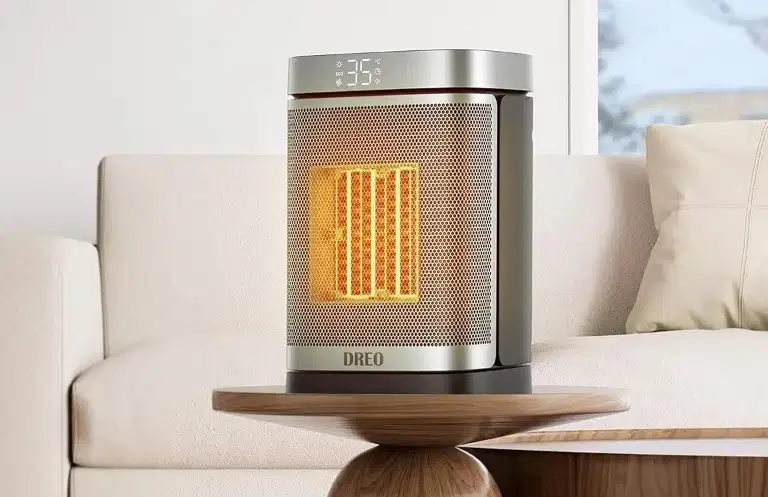
Dreo Space Heater for Bedroom: With Thermostat and Timer
If you want portable warmth for a bedroom, the DREO Atom 316 is a practical starting point, while a wall-mounted model suits you better if saving floor space is your priority. The Atom 316 is designed for targeted warmth and is specified to deliver heat in 2 seconds. Your bedroom’s layout and insulation affect how evenly that warmth reaches you.
For chilly mornings and winter warmth, a portable heater gives you flexibility to place heat near the area you use. A wall-mounted option can leave the floor open, while a quieter model may better fit your nighttime comfort routine. Each choice serves a different need, so consider how you use the room before deciding.
Key Takeaways
- The Ceramic Heater 316 suits targeted warmth and flexible placement.
- The OH712 oil-filled radiator is listed as producing no noise.
- The Smart Wall-Mounted Heater 719S keeps the floor clear.
- Room layout and insulation affect practical heating results.
- Check the model’s controls, safety instructions, and current specifications.
Choose your top priority first, whether that is portable placement, quieter operation, or keeping the floor clear.
Which Dreo Space Heater for Bedroom Fits Your Room?
For a portable heater you can move between a bedroom and another small space, start by comparing the Ceramic Heater 316 with the layout and controls you need. The right fit depends on how you use your room, not a universal ranking. Choose the format that addresses your main bedroom constraint.
A portable model can serve a bedside area, a desk, or another spot where you want focused warmth. A wall-mounted heater changes the placement equation, while a fanless radiator suits a different priority: reducing fan sound. Consider your actual sleep habits and available space before choosing.
Match the heater to the bedroom need you care about most, since portability, fan sound, and clear floor space call for different formats.
Portable warmth for a focused area
The Ceramic Heater 316 is a portable choice for targeted warmth. DREO specifies that the Atom 316 delivers heat in 2 seconds, making it a practical option when you want warmth without installing a unit. You can move a portable heater to another suitable room, too, provided you follow its instructions.
This format may work well if you want to direct warmth toward a reading chair or the area near your bed. Its usefulness depends on where you place it and how you use the room. Look at its controls and footprint alongside its listed functions, rather than choosing from stars or price alone.
Quiet operation for sleep
The Solaris 718 is listed below 25 dB, while the OH712 oil-filled radiator is listed as producing no noise. The radiator’s fanless operation may appeal if fan sound bothers you at night. That is different from choosing a compact portable design, which may rely on a fan to move warm air.
People hear sounds differently, and room conditions can affect how noticeable a running heater feels. Compare the stated noise level with your sensitivity to fan sound, then consider whether the radiator’s floor placement suits your bedroom.
A wall-mounted option for clear floor space
The Smart Wall-Mounted Heater 719S is a DREO model that mounts on a wall, leaving floor space open for furniture or walking paths. It may fit a compact bedroom where a portable unit would compete with other items. Installation and use should follow the product’s instructions.
If you cannot spare floor space, favor a wall-mounted format over a portable unit.
Heating Coverage Depends on Room Size and Insulation
A 1500-watt space heater can warm up to 150 sq. ft. as a general guide, but a drafty bedroom or high ceiling can reduce that practical coverage. Room conditions matter as much as a number on a product listing. The Ceramic Heater 316 is listed at 1500 watts with coverage of 200 sq. ft.
That product-specific figure is not the same as the general rule of thumb. A listing describes the heater’s stated coverage, while your room’s shape and heat loss affect what you feel. A long bedroom may not warm evenly if the heater sits at one end.
Ceiling height, insulation, and windows can all change heating needs. A high ceiling gives warm air more vertical space to fill. Poor insulation and drafty windows let heat escape, so the heater may need to work harder to maintain comfort.
The DREO Atom 316 is specified as having 53.9% more heating volume and a 200% longer heat range. These are product specifications, not a promise that every bedroom will feel evenly warm. Furniture placement, room shape, and air movement can affect how heat travels.
Consider where you spend time in the room, not only its total area. If you want warmth beside a bed or desk, a targeted placement may be more useful than expecting one unit to heat every corner. Keep practical expectations tied to your bedroom’s conditions.
Check the room’s square footage and drafts before treating a listed coverage figure as a guarantee.
Electricity Costs Depend on Watts and Run Time
A 1500-watt heater running for one hour uses 1.5 kilowatt-hours, so multiply 1.5 by your electricity rate to estimate that hour’s cost. Your local rate determines the dollar amount. The Ceramic Heater 316 is listed at 1500 watts.
For example, if your electricity rate is 20 cents per kilowatt-hour, one hour at 1500 watts costs about 30 cents. That example uses a sample rate, not a prediction of your bill. Find your own rate on your utility bill and apply the same calculation.
To estimate a longer period, multiply the energy used per hour by the number of hours, then multiply that result by your rate. A heater that runs for four hours uses more electricity than one running for a single hour. Your thermostat settings and how often the heater cycles also affect actual use.
A heater’s wattage is its power rating, while kilowatt-hours measure energy used over time. A 1500-watt device uses 1.5 kilowatts while operating at that level. The final cost rises with longer operation and depends on your local price per kilowatt-hour.
Use your own utility rate and expected run time instead of relying on a generic bill estimate.
Choose the Heater Format for Your Bedroom Layout
The best format is the one that fits your bedroom’s available floor or wall space and the way you want warmth distributed. Placement shapes the choice: a portable unit moves, while a wall-mounted heater stays off the floor. Match the format to the space you can dedicate to it.
Portable ceramic heaters can suit flexible use, while a wall-mounted unit can preserve floor area. An oil-filled radiator offers a different portable floor format. DREO’s Whole-Room Heater 725 uses a PTC ceramic heating element, a type of element used in ceramic heaters.
Portable ceramic heaters for flexible placement
A portable ceramic model may suit a bedroom where you want to shift the heater between suitable spots. The Ceramic Heater 316 is one example, with movable floor or stable-surface placement. Follow the manual for approved placement, since not every surface or location will be suitable.
The Whole-Room Heater 725 also uses a ceramic heating element, specifically a PTC element. Its name distinguishes it as a whole-room model, but the actual warmth you experience depends on the room. Consider the unit’s shape and the space it occupies before setting a placement plan.
Wall-mounted and radiator formats for specific needs
A wall-mounted heater can keep the floor clear, which may help in a room with limited walking space. The WH517S is one example and has an IP24 splashproof rating. IP24 indicates protection against splashing water, not a guarantee that a heater is waterproof.
A splashproof rating alone does not establish that a heater is suitable for every bathroom. Room conditions and the exact model’s instructions determine appropriate use. The OH712 oil-filled radiator is a portable floor model, so it needs space where its placement does not interfere with the room.
| Format | Example model | Placement | Best-fit consideration |
|---|---|---|---|
| Portable ceramic | Ceramic Heater 316 | Movable floor or stable surface | Flexible positioning |
| Wall-mounted | WH517S | Wall installation | Keeps floor space clear |
| Oil-filled radiator | OH712 | Portable floor placement | Fanless format |
Check the product instructions and the room’s conditions before choosing a heater for a bathroom.
Noise Levels Vary by Model
If quiet is your main concern, the Solaris 718 has the lowest listed numeric noise level among these DREO models, while the OH712 is listed as producing no noise. That distinction matters if fan sound interrupts your sleep. A listed figure does not guarantee that every person will find a heater unnoticeable.
The Atom 316 and Solaris Slim H2 are each listed below 34 dB. The Solaris 718 is listed below 25 dB. The OH712 oil-filled radiator is listed as producing no noise.
| Model | Listed noise level | Bedroom consideration |
|---|---|---|
| Atom 316 | Below 34 dB | Portable heater with a fan |
| Solaris Slim H2 | Below 34 dB | Compare with your fan-sound sensitivity |
| Solaris 718 | Below 25 dB | Lowest listed numeric figure here |
| OH712 | No noise | Oil-filled, fanless format |
The Whole-Room Heater 725 is listed at 25 dB. That figure gives you another point of comparison when reviewing DREO models. A fan may create a steady sound that some people barely notice and others find distracting.
Noise can also seem different depending on how close you sleep to the heater and how quiet the bedroom is. A published specification offers a comparison, not a guarantee of what you will hear in your own room. The heater’s operating sound may be more noticeable during a quiet night than during daytime use.
If fan sound is a deciding factor, compare the model’s listed figure with your own experience of similar sounds. You may prefer the oil-filled radiator’s listed fanless operation, or a model with a lower numeric listing. Other bedroom needs still matter when choosing.
Choose based on the noise specification and your own sensitivity to fan sound.
Thermostat Settings Differ Across Models
The Solaris Slim H2 gives you finer 1°F temperature adjustments than the Solaris 718, whose thermostat changes in 1.5°F increments. Smaller steps let you select a more precise setting. The Ceramic Heater 316 is listed with a temperature range of 41°F to 95°F.
Compare the range you can select with the size of each adjustment. Those details tell you different things: range describes the available settings, while increments show how much each change moves the set temperature.
Temperature range and adjustment increments
The Solaris Slim H2 thermostat ranges from 41°F to 95°F in 1°F increments. The Solaris 718 also ranges from 41°F to 95°F, with 1.5°F increments. Both offer the same listed endpoints, but the Slim H2 provides smaller adjustment steps.
The Ceramic Heater 316 is listed with a 41°F to 95°F temperature range. That range alone does not show the increment size. When fine adjustment matters to you, compare both details in the exact model listing rather than assuming every DREO thermostat uses the same steps.
A remote control can make it easier to change a setting from across the room, if the model includes one. The set temperature is still just the target selected on the unit. Your comfort can shift with heater placement, drafts, and how far you sit from the warm air.
How closely the heater controls its set temperature
The Solaris 718 is specified to control temperature within ±1.5°F. That stated tolerance describes how closely its control maintains the set temperature under its specified conditions. It is separate from the thermostat’s 1.5°F adjustment increment, which describes the steps available when you choose a setting.
A thermostat reading does not make every part of a room equally warm. Air near the heater can feel different from air near a window or across the bedroom. Insulation, drafts, and room layout also shape your experience, even when the display matches your selected temperature.
Compare the increment size as well as the overall temperature range if you want fine control.
Timers and Remote Controls Simplify Bedtime Use
A timer can help you limit operation to the period you actually need warmth, rather than leaving a heater running longer by default. Bedtime controls are most useful when they fit your routine. A DREO portable ceramic heater listing specifies a 12-hour timer.
Controls differ by model, so check which functions belong to the heater you plan to use. The WH517S can be set to turn off after a specified number of hours and scheduled through the DREO app. Those model-specific features are separate from general checks you can make when shopping.
A remote control can save you a trip across the room when the model includes one. Touch controls may be easier to reach when the heater sits nearby. The display and button sounds can also matter in a dark bedroom, if the selected model lets you adjust them.
- Check that the timer duration matches your bedtime routine.
- Confirm that remote or touch controls are easy for you to reach.
- Check whether the model supports scheduling through an app.
- Find out whether display brightness or button sounds are adjustable, when offered.
Review the listed functions on the exact model, since a timer or app schedule should not be assumed across the entire range. A timer gives you a set period of operation, while app scheduling may let you plan when the heater turns on or off.
Set the timer for the period you expect to use the heater and confirm the selected mode before bed.
ECO Mode Adjusts Power to Reduce Energy Use
ECO mode is designed to adjust heating behavior, but the stated savings figures should not be read as a guaranteed reduction in your bill. Actual energy use depends on how you operate the heater. Use product savings claims as model-specific estimates, not promised results.
DREO lists different ECO savings figures for several models and functions. They are not directly interchangeable because they describe different products or claims. The table keeps each statement tied to its specific model or wording.
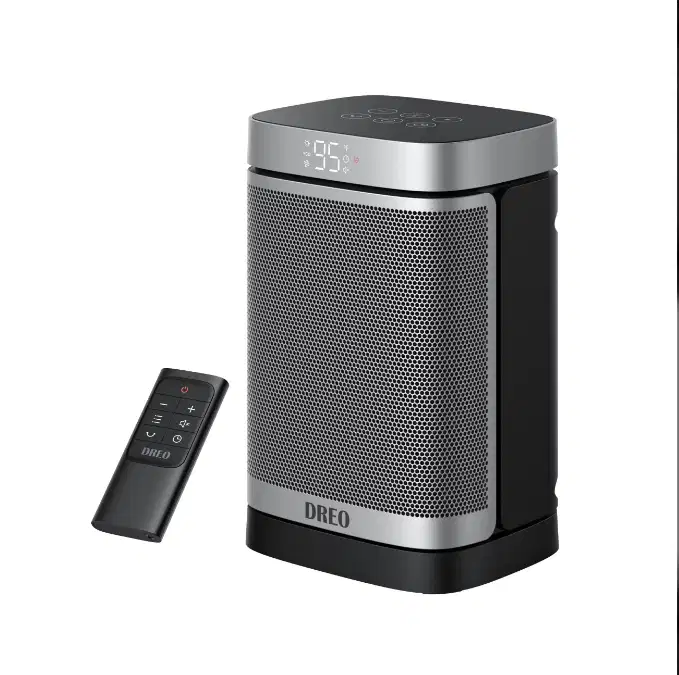
Model-specific ECO savings claims
| Model or claim | Stated saving | How to interpret it |
|---|---|---|
| Atom 316 | 40% less energy in ECO mode | Claim applies to this model’s ECO mode |
| OH712 | Up to 60% energy savings | “Up to” is a maximum stated figure |
| Whole-Room Heater 725 | 40% energy savings | Claim applies to this model |
| DREO ECO mode and precise temperature control | Up to 50% on energy bills | General claim, not a bill guarantee |
Use temperature control without assuming a guaranteed bill reduction
Energy use depends on your set temperature, operating pattern, room conditions, and electricity rate. A heater in a drafty bedroom may run differently from one in a well-insulated room. Your bill also reflects the local price of electricity and the time you operate the unit.
ECO mode is intended to adjust how the heater responds to temperature and heating demand. Check the model’s description to understand how that mode works on your selected unit. A claim for one model should not be assigned to another model without its own listing.
If you want to compare options, consider the function behind the figure as well as the percentage. An “up to” claim marks a possible upper result, not a typical outcome for every home. Use your planned settings and run time to judge whether the feature suits your routine.
Compare the stated ECO function with your own set temperature and planned run time.
Bedroom Heater Safety Features to Check
For a bedroom heater, first check whether the exact model has tip-over and overheat protection, then confirm its safety instructions and labeling. Model-specific checks matter because features differ across products. A feature list does not replace using the heater as instructed.
The Solaris 718 automatically shuts off if it tips over. The MC706 has tip-over and overheat protection that automatically shut it off. DREO’s 25-inch heater listing also specifies overheating and tip-over protection.
Automatic shutoffs and overheating protection
Tip-over protection is intended to shut a heater off if it falls, while overheat protection responds to excessive heat inside the unit. These functions address different risks. Check the exact model’s instructions to learn which protections it includes and how they operate.
Do not assume a feature on one DREO heater is included on another. The name, size, and appearance of two units do not establish that their safety functions match. Read the product details for the particular model you are considering.
Surface-temperature testing and safety labels
Safety checks also include how hot a heater’s surfaces become. Consumer Reports tested more than 80 space heaters in its laboratory ratings and excluded heaters that failed its hot-surface test. That testing is a useful consideration alongside the exact product’s labeling.
Use this checklist when comparing a bedroom space heater:
- Check whether the model has a tip-over shutoff.
- Check whether it includes overheat protection.
- Look for a recognized safety certification or label on the exact model.
- Consider hot-surface risk around people, bedding, and nearby items.
A product feature list is only one part of safe use. The manual explains how the unit is meant to be operated, and its instructions apply to that model. Do not rely on a general product description to replace those directions.
Do not use a heater with damaged housing or a damaged power cord.
Safe Placement and Plugging Rules
Keep a portable heater at least 3 feet from curtains, blankets, furniture, and other flammable materials. Clear space around the unit helps reduce fire risk. DREO recommends plugging a space heater directly into a wall outlet, not an extension cord or power strip.
Placement and power connection both matter during everyday use. A bedroom can contain bedding, curtains, and furniture close together, so choose a spot with enough room around the heater. Follow the product instructions for the model’s specific setup.
- Keep at least 3 feet from curtains, bedding, blankets, and furniture.
- Place a portable model on a stable, level surface.
- Keep the air outlet clear.
- Plug the heater directly into a wall outlet, not an extension cord or power strip.
Do not position items where they can fall against the heater or block its air outlet. A clear path for airflow supports normal operation. Recheck the area if you move the unit or rearrange the bedroom.
A power strip or extension cord is not a substitute for a wall outlet with the heater. Keep the cord routed so it does not become a trip hazard or get caught under furniture. Check the connection during use if you notice unusual heat or damage.
If the power cord or outlet becomes hot, stop using the heater and address the issue before turning it on again.
Dreo Heater Prices, Returns, and Warranty
The listed prices for these four DREO options range from $39.99 for the Ceramic Heater 316 to $129.99 for the Smart Wall-Mounted Heater 719S. These listed prices can change with the current offer. Check the price and purchase terms shown for the model you choose.
Listed prices for selected DREO models
| Model | Listed price | Format |
|---|---|---|
| Ceramic Heater 316 | $39.99 | Portable ceramic |
| Whole-Room Heater 725 | $79.99 | Whole-room heater |
| Whole-Room Heater 720 | $119.99 | Whole-room heater |
| Smart Wall-Mounted Heater 719S | $129.99 | Wall-mounted heater |
Prices shown on a sale page may change, so the listed amount is not a permanent price. Check whether the amount applies to the model and configuration you intend to buy. Do not assume that a discount for one item applies to another.
Return window, delivery, and warranty terms
Undamaged products may be returned within 30 days for a full refund. For a non-defective return, the buyer pays return shipping. These terms give you a defined return window, but the return condition and shipping cost matter when you decide whether to send an item back.
New products have a 12-month warranty covering material defects and workmanship. The warranty applies to new products and the stated kinds of defects. Keep the purchase details and review the terms that apply to the particular item.
Estimated U.S. delivery is 3-7 business days, with free shipping subject to restrictions. Delivery timing is an estimate, and shipping restrictions may affect whether free shipping applies. Check the order details for the delivery estimate and any conditions before checkout.
Check the current listing and the terms that apply to your purchase before ordering.
How to Read Dreo Heater Ratings and Reviews
A high star rating is a useful starting point, but the review count and the exact model listing matter too. Context changes the comparison when models have different review pools. Compare ratings within the listing for the model you may buy.
The Ceramic Heater 316 has a 4.7/5 customer rating from 465 reviews. The Whole-Room Heater 725 has a 4.9/5 rating from 26 reviews, while the Whole-Room Heater 720 has 4.9/5 from 34 reviews.
Compare ratings only within their listing context
The Smart Wall-Mounted Heater 719S has a 4.9/5 rating from 308 reviews. A DREO 1500W portable heater listing has a 4.8/5 rating from 32 reviews. These figures describe different listings and review counts, so they do not establish one universal winner.
Stars summarize customer ratings, while the number of reviews shows how many ratings contribute to the displayed score. A score drawn from 26 reviews does not represent the same review pool as one drawn from 465. The exact listing also matters because similarly described heaters may not be the same model.
Look for details that match your bedroom
Read comments about room size, noise, remote use, and reliability. Those details may help you judge whether a customer’s experience resembles your bedroom and routine. One person’s experience remains anecdotal, even when it describes a specific issue or benefit.
Consumer Reports tested more than 80 space heaters in its laboratory ratings. That testing is distinct from customer reviews, which describe individual experiences in homes. You can consider both types of information without treating either a star score or one comment as a complete verdict.
Look for comments that explain the customer’s room, placement, and frequency of use. A review about an open living area may not predict how a heater feels in a compact bedroom. Likewise, feedback about a remote matters most if you plan to use that control often.
Favor reviews that describe a room and use pattern similar to yours over a rating alone.
Seasonal Care Keeps the Heater Ready
Before cleaning or storing a heater, turn it off, unplug it, and let it cool fully. Start with a cool unit before removing dust or checking its parts. Follow the model’s manual for every cleaning step.
Portable and wall-mounted heaters may have different care instructions. The Ceramic Heater 316 package includes a user manual and quick start guide. DREO sells distinct portable and wall-mounted models, including the Atom 316 and Smart Wall-Mounted Heater 719S.
Cleaning and checking the unit
Once the heater has cooled, remove accessible dust only as directed by the manual. Do not open the casing or reach inside unless the model’s instructions specifically allow that task. Cleaning methods that suit one design may not suit another.
Check the cord and outer casing for wear, cracks, or other visible damage before putting the heater away. Keep the unit’s instructions with it, so you can refer to the right guidance later. A wall-mounted model may need different care than a portable unit.
Storing and restarting it
Store a clean, fully cooled heater in a dry place. Keep the manual with the unit so its instructions remain available when the heating season returns. Choose storage that protects the casing and cord from damage.
Do not use a cleaning step that reaches an intake, filter, or internal component unless the model’s manual directs you to do so.
Before restarting a stored portable heater, inspect its visible condition and confirm that its controls work as described in the manual. A wall-mounted unit may remain installed and follow a different seasonal routine. Use its own care instructions rather than applying portable-heater steps by default.
- Turn off and unplug the unit before cleaning.
- Let the heater cool fully before handling it.
- Remove accessible dust only as the manual directs.
- Check the cord and casing, then store the unit in a dry place.
Use the model’s manual for any cleaning step that involves an intake, filter, or internal component.
Conclusion
Choose the DREO model that matches the bedroom constraint you care about most, rather than buying on one feature alone. Your first priority may be portable warmth, quieter operation, or keeping floor space clear. Room fit and your daily routine should guide the choice.
A portable heater can give you flexibility, while another format may better suit a bedroom where fan sound or floor space matters more. Consider how the unit will fit into your home and how you plan to use its controls. A lower price or higher star rating does not settle that fit by itself.
- Choose portable placement if you want to move warmth between suitable spaces.
- Compare listed noise specifications if quiet operation matters most.
- Consider a wall-mounted format when keeping the floor clear is your priority.
Before buying, check the chosen model’s current specifications, operating modes, and instructions. Confirm that its controls and placement suit your bedroom, then read the safety directions for that exact unit. Check the current model details and safety instructions, then choose the heater that fits your room and routine.
FAQ
How many amps does a 1500-watt DREO heater draw on a 120-volt circuit?
A 1500-watt DREO heater draws 12.5 amps on a 120-volt circuit. The calculation divides watts by volts: 1500 divided by 120 equals 12.5. Other appliances on the same circuit use part of its capacity, so their combined load matters. Do not assume the circuit has its full capacity available for the heater alone.
Does an IP24 rating mean a heater is waterproof?
No, an IP24 rating indicates protection against splashing water, not waterproofing. The rating does not mean you can submerge a heater or use it in any wet location. Check the exact model’s instructions for where it can be installed and operated. A splash-protection rating by itself does not establish that a heater is suitable for bathroom use.
Can I leave a portable space heater running while I sleep?
Turn off a portable space heater before you go to sleep or leave the room, and follow the model’s safety instructions. A timer or thermostat does not replace the directions for safe operation. Set the controls before bedtime, then switch the unit off rather than relying on it to run unattended overnight.
How often should I clean a bedroom space heater?
Check and clean a bedroom space heater before the heating season and whenever dust builds up. The exact method depends on the model, so the product manual takes precedence over general cleaning steps. Turn the heater off, unplug it, and let it cool fully before cleaning. Remove only accessible dust as the instructions allow.
Can I use an extension cord with a DREO space heater?
No, DREO recommends plugging a space heater directly into a wall outlet, not an extension cord or power strip. A cord or strip is not the recommended connection for the heater. Keep the power cord arranged so it does not become trapped or damaged during use, and stop operating the heater if the cord or outlet becomes hot.
Will a DREO heater’s thermostat make the whole bedroom exactly the set temperature?
No, a DREO heater’s thermostat does not make every part of a bedroom exactly the set temperature. The reading and your comfort can differ with heater placement, drafts, insulation, and distance from the unit. Air near the heater may feel warmer than air near a window or across the room, even when the display matches your setting.